What’s the Most Common Personal Color Tone in Korea? — A Practical Guide to Telling Confusing 14-Season Tones Apart
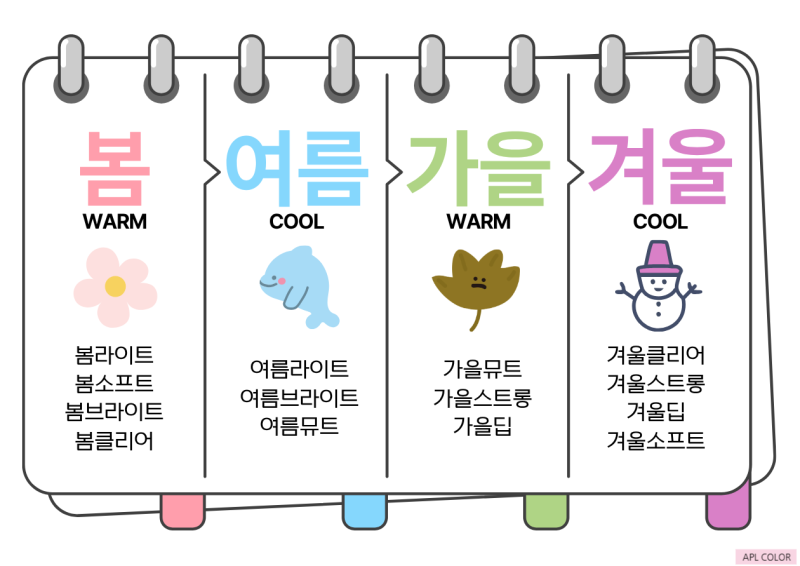
Ever gotten a personal color diagnosis and thought, “Wait, why am I Winter, but Soft?” or “Am I Spring Light or Autumn Mute?” — and felt totally confused? There are 14 season names in total, but in practice several tones overlap so closely that mix-ups are common. In this article, we’ve grouped the questions and confusion points APL hears most often in real consultations and diagnoses, tone by tone.
APL’s 14-Season Naming System
APL COLOR diagnoses using a 14-season naming system based on the KS color system. The 14 names actually in use are:
- Spring: Spring Light · Spring Soft · Spring Bright · Spring Clear
- Summer: Summer Light · Summer Bright · Summer Mute
- Autumn: Autumn Mute · Autumn Strong · Autumn Deep
- Winter: Winter Clear · Winter Strong · Winter Deep · Winter Soft
Even within a season, four overlapping attributes — value (brightness), chroma (intensity), warm/cool (temperature), and clarity (clear vs. muted) — split tones into sub-types. We covered these four attributes and self-checks in detail in Same ‘Spring,’ Different Colors — The 4 Attributes That Define Your Personal Color, so this article focuses on which tones are commonly confused in practice, and how to tell them apart — with real examples.
The Tones People Confuse Most — And How to Tell Them Apart
| Confusing Pair | The Deciding Factor | Real Examples |
|---|---|---|
| Spring Light vs. Spring Soft vs. Autumn Mute | Whether muted tones work for you — Spring Light suits clear pastels, Spring Soft suits soft, soy-milk-like pastels, Autumn Mute suits muted tones best | — |
| Summer Light vs. Summer Mute | Summer Light suits clear pastels best; if muted, calm tones suit you better, that’s Summer Mute (muted ≠ Summer Light) | — |
| Summer Bright vs. Winter Clear | Summer Bright suits mid-chroma best (extreme high chroma overwhelms); Winter Clear needs a very clear, sharp “clarity” quality | Taeyeon = Summer Bright, Joy = Spring/Winter Clear (high chroma) |
| Bright vs. Clear | Bright = radiant, lively (high value, mid chroma); Clear = clean and sharp (low-chroma whitish or high-chroma vivid) — if mid-chroma colors suit you, you’re Bright; if clean whitish or sharp vivid colors suit you, you’re Clear | Chuu, Jang Wonyoung = Bright; IU, Eunchae = Clear |
| Winter Soft vs. Autumn Mute vs. Winter Deep | Winter Soft is a restrained cool-winter tone (clarity-influenced, no yellow undertone); Autumn Mute is a warm muted tone; Winter Deep can wear a single deep, dark color without looking heavy | Moon Ga-young = presumed Winter Soft |
The #1 Point of Confusion — “Why Am I Winter, But Soft?”
This is one of the most common questions APL gets in real consultations. Winter Soft used to be called “Winter Dark” — it was later broken out as its own official name so clients could work with a wider range of colors.
Winter Soft self-check
- Pale Summer pastels wash you out, and bold Winter primary colors feel heavy on you (Winter Soft sits in between)
- Colors with a whitish or neon quality don’t suit you (off-white or grey-blended pastels work better)
- Extreme black-and-white contrast looks awkward; restrained mid-to-high contrast — like ink black with off-white — works better
- Yellow undertones make you look stuffy and warm (self-diagnosis often lands on Autumn Mute here, but the presence of a yellow undertone is what separates the two)
- Wearing muted tones alone drains your look — you need contrast from hair, bottoms, or accessories to look polished
👉 Best outfit combos: off-white + charcoal/ink-black pants · soft-black suit + lavender/light blue · charcoal/ink-black coat + light grey knit
Styling Tip — Even Toned-Down Hair Dye Colors Vary by Tone
Some of APL’s recommended toned-down hair dye colors clearly split by season.
- Dark matte brown (matte brown with no yellow, red, or orange undertone): recommended for Spring Light · Spring Soft, lukewarm Summer Mute, Autumn Mute, lukewarm Winter Soft
- Ash black (soft dark ash brown): recommended for Summer Light · Summer Mute · Summer Bright, Winter Soft
- Dark red-brown: recommended for Spring Bright · Spring Clear, Autumn Strong · Autumn Deep, lukewarm Winter Deep · Winter Strong · Winter Clear
- Blue-black: recommended only for extreme cool tones like Winter Clear · Winter Strong · Winter Deep
Even the same “brown” splits into completely different best-matches depending on tone — dark matte, ash, red, or blue-black each suit a different group.
Real Cases on Social Media, Too
APL’s official Instagram has plenty of real diagnosis and consultation cases in these tones. Spring Light, Autumn Mute, and Summer Light show up especially often, while Winter tones appear relatively less.
👀 See real cases: Spring Light · Autumn Mute · Summer Light · Winter Soft
Takeaways
- Tell Spring Light, Spring Soft, and Autumn Mute apart by whether muted tones work for you — remember Summer Light = clear pastels, Summer Mute = muted tones.
- If mid-chroma colors suit you, you’re Bright (radiant); if clean whitish and sharp vivid colors both suit you, you’re Clear (sharp).
- If you’re stuck on “Winter, but Soft?” — check whether Summer colors wash you out and Winter colors feel heavy, how well you handle muted colors and how much contrast you need, and how yellow undertones show up, to separate it from Autumn Mute and Winter Deep.
Curious where your tone falls among these confusing combinations? Get an in-depth APL COLOR diagnosis to find out for sure. 🙌
Sources (color-coding indicates source): blog posts from 2025-01-20 (14-season names), 2025-04-14 (4 attributes), 2025-09-04 (official 14-season list, overlapping tones), 2025-09-11 (Winter Soft), 2025-12-16 (Bright vs. Clear), 2025-10-21 (toned-down hair dye colors — images sourced from Pinterest and not used, text only) · Instagram post links (case examples, not statistics) · uncolored text was written in-house.
Also see: Same ‘Spring,’ Different Colors — The 4 Attributes That Define Your Personal Color (same series, covers theory and self-checks)
APL COLOR offers personal color diagnosis combining LS170 spectrophotometer LAB measurement with expert draping analysis. Explore our professional courses →